The breed gallery
Golden Retriever
The Golden Retriever arose on a Scottish estate, out of the wish of a sportsman for a dog that would retrieve without damage. What he got was a working dog with a soft mouth — and, unintentionally, one of the friendliest family dogs in the world.
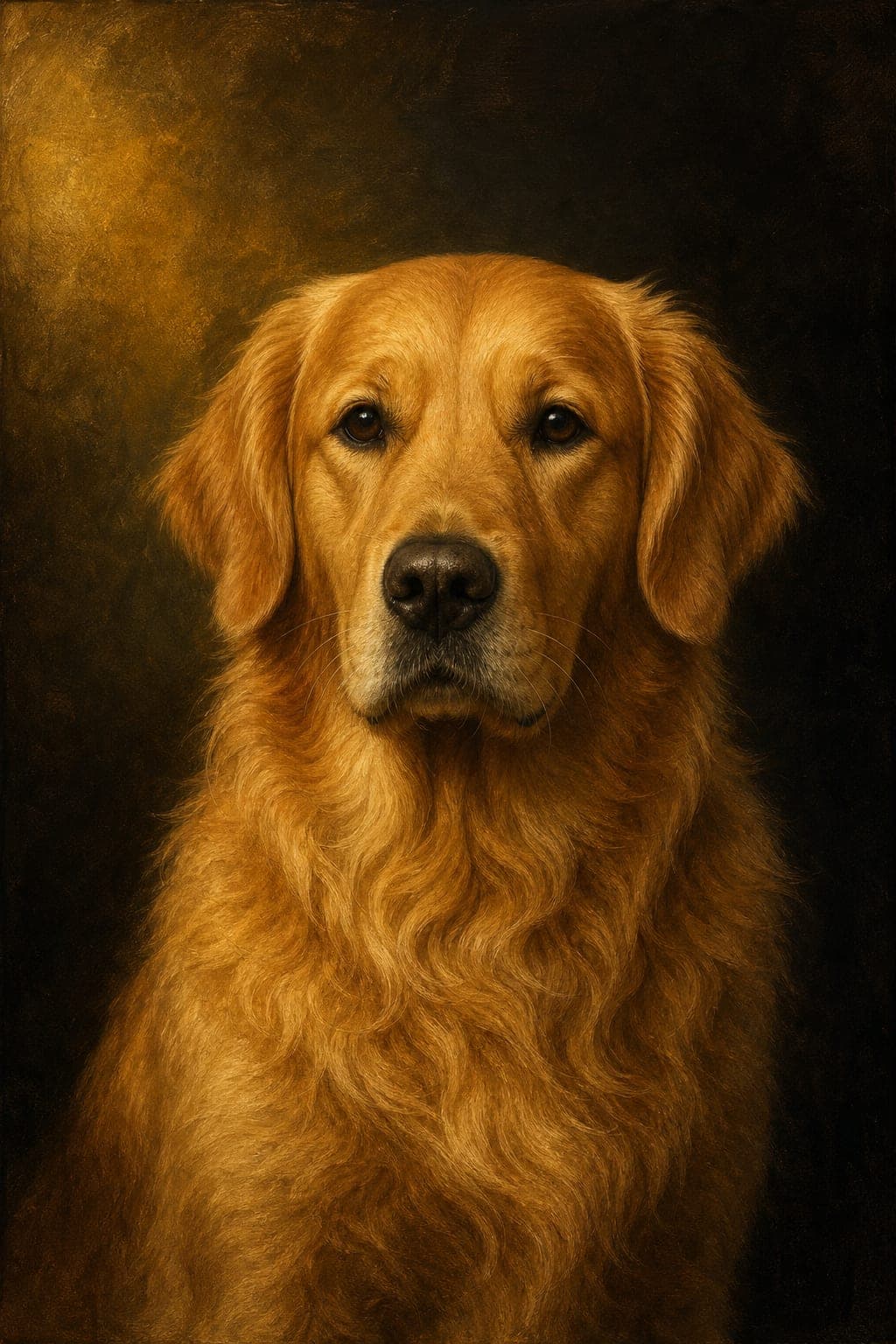
For a portraitist the Golden is a study in light: the feathering on chest, legs and tail catches every ray and gives it back softened.

- Origin
- Scotland, second half of the 19th century — the Guisachan estate
- Coat
- semi-long, flat or wavy, with feathering and a dense water-repellent undercoat
- Colours
- any shade of gold or cream; red and mahogany fall outside the standard
- Height
- males roughly 56 to 61 centimetres; females roughly 51 to 56 centimetres
- Life expectancy
- roughly 10 to 12 years
- Character
- gentle, patient and obliging — a dog that likes to join in
Character
The Golden Retriever is the diplomat among family dogs: patient with children, tolerant towards other animals and rarely inclined to quarrel. He asks for attention the polite way — a head against a knee, a toy in the mouth, and waiting.
Work he does need. The breed excels at retrieving, detection and assistance work, and a Golden given nothing to do invents his own occupation: usually something out of the laundry basket.
Appearance and coat
The coat lies flat or lightly waved over a dense undercoat that keeps the dog dry in cold water. The colour runs from near cream to deep gold; red and mahogany sit outside the standard, however often they turn up.
A Golden is painted not with paint but with light; the coat does the rest.
The head is broad with a friendly expression, the eyes dark brown and well apart, the ears medium and close to the cheeks. The feathering on chest, hindquarters and tail gives the silhouette its soft edge.
Care
Two brushings a week keep the feathering free of tangles, daily during the moult. Mind the ears: hanging and hairy, they hold moisture. The breed is also prone to hip and elbow dysplasia — ask a breeder about the screening of the parent dogs.
History
From 1868, on his Guisachan estate in the Scottish Highlands, Lord Tweedmouth crossed a yellow retriever with the now-extinct tweed water spaniel. His stud books survive, which makes the Golden Retriever one of the best-documented breeds there is; recognition followed in 1913.
The portrait
Your Golden Retriever as an art portrait
The Golden is the breed where a style should above all force nothing: the coat already carries the portrait. Choose a photograph in soft daylight — late afternoon sun or an overcast sky — and the feathering does what it does at every sunset.