The breed gallery
French Bulldog
The French Bulldog is a product not of the hunt but of the city. Small bulldogs travelled with English lace workers to Normandy and Paris, where in the nineteenth century they grew into the dog of market traders, artists and cafés — with the upright bat ears as their trademark.
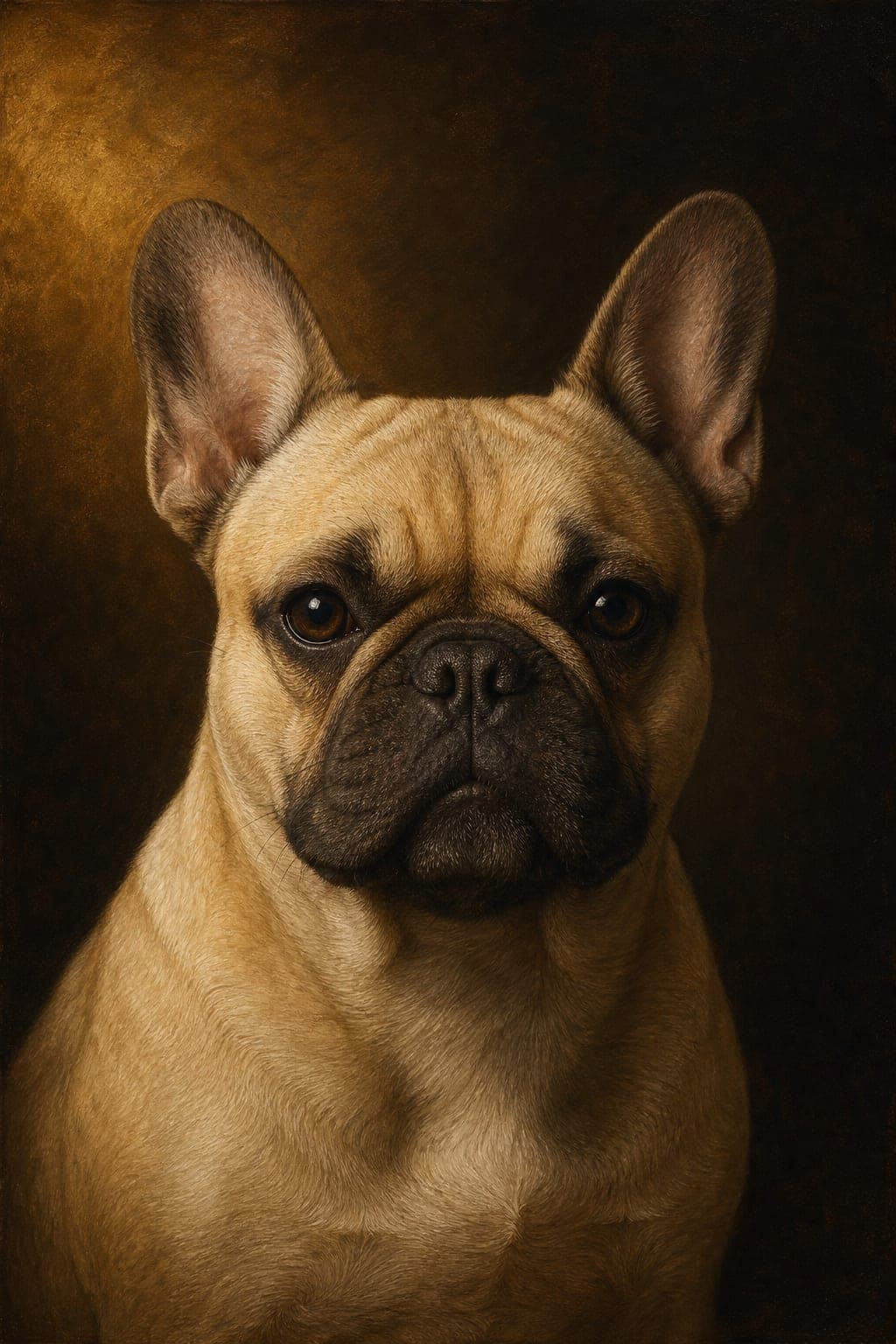
At the workbench this is a graphic sitter: no coat to get lost in, only form. Two ears, a short muzzle and two round eyes that hold the viewer.

- Origin
- France, 19th century — from the small bulldogs of English workers
- Coat
- short, smooth and glossy; brindle, fawn, pied or white
- Ears
- upright with a rounded tip — the bat ears of the standard
- Weight
- roughly 8 to 14 kilos
- Life expectancy
- roughly 10 to 12 years
- Character
- affectionate, comic and calm indoors — a companion dog through and through
Character
The French Bulldog is company in the most literal sense: he wants to be in the same room, preferably on the same chair. He barks little and his need for walking is modest — a flat suits this breed better than a meadow.
What he does ask for is presence. Long days alone the breed tolerates poorly; anyone who works from home gains a colleague who accompanies every deliberation with a sigh.
Appearance and coat
Everything about the French Bulldog is short and firm: a compact, muscular body, a broad chest, a short tail and a smooth coat in brindle, fawn or pied. The skin forms folds around the muzzle and shoulders that make a marking of themselves in raking light.
With a French Bulldog the portraitist need leave nothing out; the breed is already a silhouette.
The ears are the trademark: broad at the base, rounded at the tip and always upright. Together with the flat muzzle and the widely set eyes they make the most recognisable head in the world of dogs.
Care
The short coat asks for little more than a weekly grooming mitt; the skin folds do ask for attention and must be kept dry. The most important point with this breed is the breathing: the short muzzle makes heat dangerous. Walk early in summer, never in full sun, and choose a breeder who selects for open nostrils and free breathing.
History
When the English lace industry moved to Normandy in the nineteenth century, the workers’ small bulldogs went with it. In Paris they became the dog of the markets and of the bohemians; Toulouse-Lautrec drew Bouboule, the bulldog of the café keeper Palmyre. The upright ears, contested at first, became the standard at the insistence of American fanciers.
The portrait
Your French Bulldog as an art portrait
No breed gains as much from a graphic style as the French Bulldog: planes, lines and hard contours do exactly what his head already does. Photograph head-on and at eye level — the ears are the composition.