The breed gallery
Dachshund
The Dachshund is a hunting dog in the body of a joke, and he knows nothing of either. German hunters bred him to face a badger in its own tunnel: short of leg to fit in, long of body to turn around in there, and brave enough to stay.
At the workbench the Dachshund is a problem of composition and a gift at once: the longest silhouette in the world of dogs, with a head that always looks slightly upward.

- Origin
- Germany — a hunting dog on badger and fox; standardised in the 19th century
- Coat
- three varieties: smooth-haired, long-haired and wire-haired
- Sizes
- standard, miniature and rabbit — classed by chest circumference
- Weight
- the standard dachshund up to roughly 9 kilos; the smaller sizes lighter
- Life expectancy
- roughly 12 to 16 years
- Character
- wilful, brave and affectionate — a hunter with a sitting-room voice
Character
Give a Dachshund an order and you first receive a consideration. The breed was bred to decide alone underground, and that independence is still there: he listens excellently as soon as he agrees. Obedience with this breed is a negotiation that usually ends well.
At home he is affectionate and watchful, with a surprisingly deep voice for his size. Digging remains a need — a garden, a blanket or a laundry basket, he always finds something.
Appearance and coat
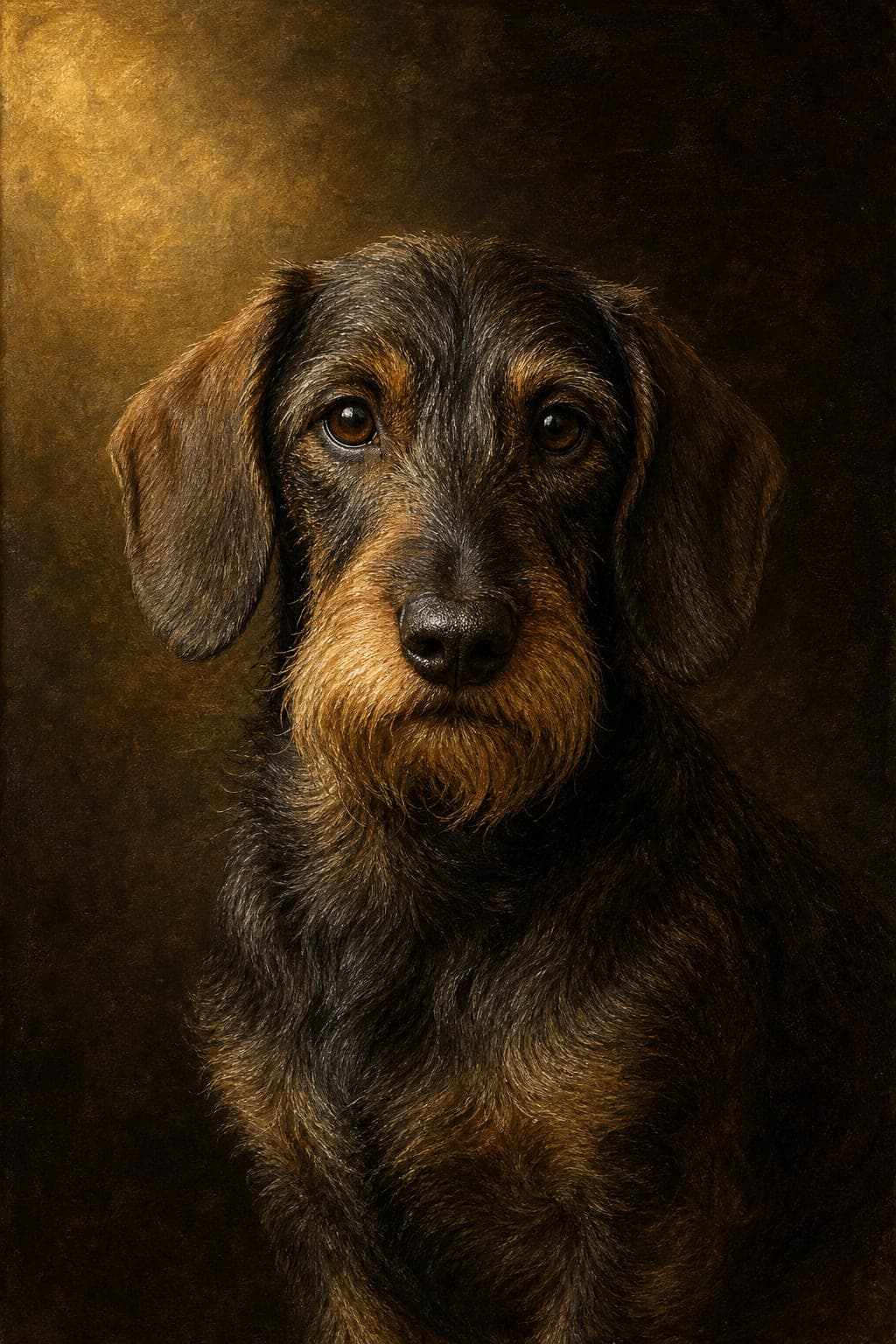
Three coats, three faces: the smooth-haired is sleek and glossy, the long-haired carries silken feathering on ears, chest and tail, and the wire-haired has a hard coat with beard and eyebrows. The colours run from solid red to black and tan, brindle and dapple.
A Dachshund is one continuous line — catch the head at eye level and the rest comes for free.
The body is low and long, the chest deep and oval, the ears hang long and broad along the cheeks. The eyes are oval and dark, with an expression at once self-assured and friendly.
Care
The smooth-haired dachshund asks little, the long-haired a weekly brushing and the wire-haired a few strippings a year. More important than the coat is the back: this breed is prone to spinal trouble. Keep the weight low, limit stairs and jumping, and always lift him with two hands.
History
Sixteenth-century German hunting books already describe short, low-built dogs sent into badger setts. In the nineteenth century German breeders fixed the three coat varieties and the three sizes; soon afterwards the dachshund became what he mostly is now — a city dog with a hunter’s heart.
The portrait
Your Dachshund as an art portrait
The Dachshund dictates the composition: the long body seldom lets itself be pushed into a classical frame, so the portrait turns on the head, the ears and the upward gaze. Photograph low, at his eye level rather than yours.